Publication Frequency
03-03-2026

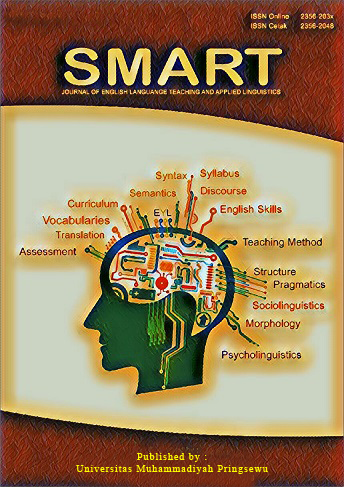
JURNAL SMART
Journal of English Language Teaching and Applied Linguistics
JURNAL SMART was first published in 2015 as an academic journal dedicated to advancing research in English Language Teaching and Applied Linguistics. Since its inception, the journal has served as a platform for scholars, researchers, and practitioners to disseminate high-quality research and theoretical contributions.
Initially, the journal focused on areas such as English language teaching and learning, teacher education and training, language assessment, translation, vocabulary studies, curriculum and syllabus design, semantics, syntax, discourse analysis, pragmatics, sociolinguistics, morphology, psycholinguistics, and English language skills and teaching methods.
Over time, the journal has expanded its scope to reflect contemporary developments in language studies. The current areas of interest include:
JURNAL SMART strongly encourages authors to submit manuscripts through the online submission system. Authors must first register, select the “Author” role during registration, and log in to submit their manuscripts and monitor the review process.
Accreditation
In 2025, JURNAL SMART proudly achieved SINTA 4 Accreditation, as confirmed by the Decree (Surat Keputusan) of the Ministry of Education, Culture, Research, and Technology (Kemendikbudristek) No. 10/C/C3/DT.05.00/2025. This accreditation reflects the journal’s commitment to maintaining academic quality and contributing to the advancement of research, particularly in language education and applied linguistics.
Publication Schedule
JURNAL SMART publishes two issues annually, in January and August.
For the January issue, manuscript submission is open from July to October (of the preceding year). The peer-review and revision process is conducted from September to November, followed by final acceptance, editing, and layout preparation in December to ensure timely publication.
For the August issue, manuscript submission is open from February to May. The review and revision process takes place between April and June, with final acceptance and layout preparation completed in July prior to publication.
This structured publication schedule ensures systematic editorial management, academic alignment, and consistency within each volume year.
Through its accredited status and continuous quality improvement, JURNAL SMART aims to expand its impact among researchers, academics, and practitioners by providing access to and publication opportunities for relevant, rigorous, and high-quality scholarly work.
In this issue, JURNAL SMART proudly features contribution not only from Indonesian scholars but also from international authors, including researchers from Iran and India.
Jurnal Smart has been indexed by :
  |
 |
 |
 |
 |
|




Jurnal Smart is licensed under a Creative Commons Attribution- 4.0 International Public License (CC - BY - SA 4.0).